High Level Vacuuming
High level vacuuming is the method behind most of what we do. Dust is drawn from the surface into a HEPA-filtered industrial vacuum at floor level, so it leaves the building with us rather than landing on whatever is below.
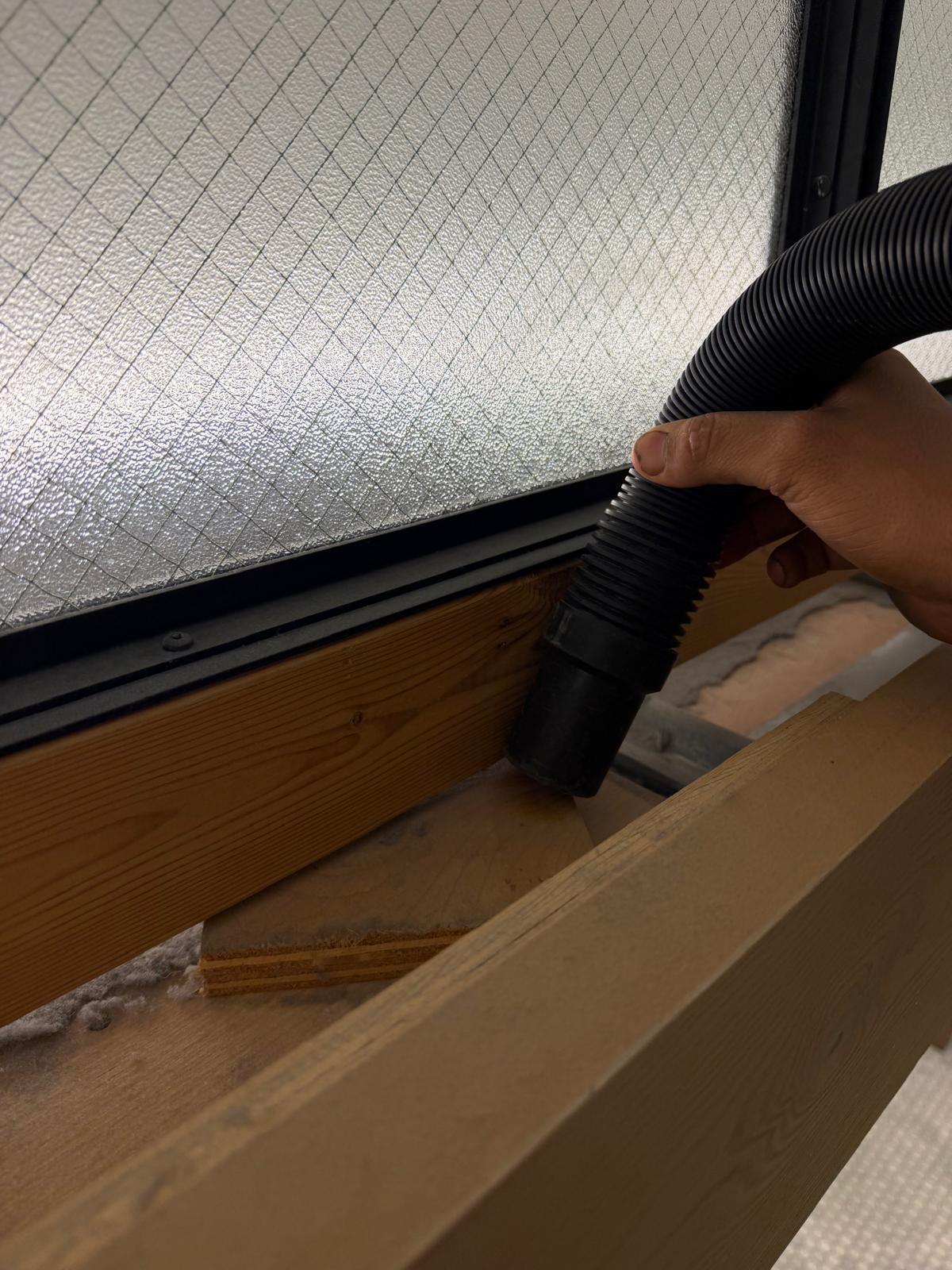
High level vacuuming is the method behind most of what we do. Dust is drawn from the surface into a HEPA-filtered industrial vacuum at floor level, so it leaves the building with us rather than landing on whatever is below.
There are three ways to get dust off a high surface. You can blow it down with compressed air, brush it down, or vacuum it away. The first two move the problem somewhere else, usually onto the floor, the stock or the production line underneath. In a combustible dust environment they also create the airborne cloud that makes an explosion possible.
High level vacuuming does the opposite. A carbon fibre telescopic pole carries a vacuum head to the surface, and the dust travels down the hose into a sealed HEPA-filtered unit on the floor. Nothing is dispersed, and the fine particulate that would pass straight through an ordinary shop vacuum is captured rather than blown back into the room.
Heads are changed for the surface: soft brushes for structural steel and duct exteriors, narrow tools for conduit and congested service runs, and flat tools for ledges and beam tops where accumulation is deepest. The camera at the pole head shows what the surface looked like before and confirms it afterwards.
Where a surface is beyond ground reach, the same vacuum method is used from powered access up to 75 feet.
Structural ledges and beam tops, roof deck flutes and open joists, the top face of ductwork and conduit, cable trays, sprinkler lines, and any overhead surface where dust has been allowed to build into a measurable layer.
Dust is captured and removed from the building rather than relocated downward, the space below stays usable during and after the work, and HEPA filtration means fine particulate is not returned to the air.
Industrial HEPA-filtered vacuum units at floor level, carbon fibre telescopic poles, interchangeable vacuum heads for flat, curved and congested surfaces, and camera-mounted inspection tools.
Vacuum extraction is the appropriate method for combustible dust because it avoids dispersion. Equipment selection accounts for the material being removed. Powered access work is carried out by Working at Heights trained, licensed operators under a site-specific hazard assessment.
From the floor to 75 feet, we'll assess your facility and recommend the right approach.
Book A Site Assessment